



AFEE congratulates the 2026 Veblen-Commons Award Recipient, Clarence Ayres Scholar and James H. Street Scholar!
Veblen-Commons Award
The Veblen-Commons Award is the highest honor given annually by the Association for Evolutionary Economics (AFEE), in recognition of significant contributions to evolutionary institutional economics.
Wolfram Eisner
University of Bremen (Germany) (retired)
We are honored to announce that Dr. Wolfram Elsner, Emeritus Professor of Economics, was presented the Veblen-Commons award at the annual meeting of the Association for Evolutionary Economics (AFEE) in January 2026. The Veblen-Commons award is AFEE’s most prestigious award and is given in recognition of career excellence. Dr. Elsner’s acceptance speech, “Contributing to EIE/OIE …a long and winding road” is published in the June 2026 issue of the Journal of Economic Issues. https://www.tandfonline.com/doi/full/10.1080/00213624.2026.2657201“

Wolfram Elsner, PhD is a Professor of Economics (retired), University of Bremen, Germany; he graduated at the Universities of Cologne (MA, 1974) and Bielefeld (PhD, 1977), Germany; after “Habilitation”(U Bielefeld, 1985), he worked for ten years outside academia in regional development at city and state levels; Managing Editor, Forum for Social Economics (FSE), 2012-2018; President, European Association for Evolutionary Political Economy (EAEPE), 2012-2014 and 2014-2016; taught in many European countries, in the USA, in South Africa, Australia, Mexico, and China; Textbook Microeconomics of Complex Economies (Elsevier/Academic Press, 2015), which received the biannual Gunnar-Myrdal Award 2017 of the EAEPE; edited a number of books and book series; authored numerous international peer-reviewed book chapters, journal articles, and books; Editor-in-Chief, Review of Evolutionary Political Economy (REPE), 2018-2023;served as a member of the Board of Directors, Association of Evolutionary Economics (AFEE), and member of Executive Council and Trustee, Association of Social Economics (ASE); served on numerous committees of AFEE and ASE; research areas: Social Economics, Evolutionary, Institutional, and Complexity Economics, applied fields in industrial and regional economics, and policies; headed or served as reviewer and examiner in around 60 PhD promotions in Germany, Austria, UK, USA and in around eight professorial habilitations; generated seven professors from his ex-PhD-students and RA/TAs (1 USA, 1 UK, 2 China, 3 Germany); received the ASE Service Award in 2023 for editing the FSE; received the Best Paper Award 2024 of the Journal of Economic Issues.
Clarence Ayres Scholar
The Clarence E. Ayres Scholar is awarded to an international scholar for outstanding work in the area of institutional economics.
Franklin Obeng-Odoom
University of Helsinki (Sweden)
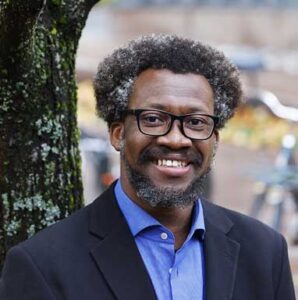
Franklin Obeng-Odoom, the 2026 Clarence Ayres Scholar, holds a PhD in Political Economy from the University of Sydney, Australia. He is currently Professor of Global Development Studies at the University of Helsinki, Finland, from where he contributes to institutional evolutionary economics as a teacher and as Associate Editor of the Forum for Social Economics, the Review of Social Economy, and the Review of Evolutionary Political Economy. He is also on the editorial board of the Journal of Economic Issues.
Obeng-Odoom’s research on the political economy of development, urban and regional economics, stratification economics, natural resources and the environment has won many awards, including the KW Kapp Prize, Patrick Welch Prize, and the Joan Robinson Prize. His popular writings have also been recognised with the Kurt Rothschild Award for Economic Research and Journalism. Professor Obeng-Odoom is considered a leading social scientist. He is a Fellow of the Ghana Academy of Arts and Sciences, a Member of the Finnish Academy of Science and Letters, and a Fellow of the Academy of Social Sciences.
James H. Street Scholar
The James H. Street Scholar is awarded annually for outstanding scholarship in Latin America in the area of economic development, from an Institutionalist perspective.
Beliza Borba de Almeida
Federal University of Parana (Brazil)

Beliza Borba de Almeida is a Brazilian independent scholar working in the fields of philosophy of economics and the history of economic thought from an Original Institutionalist perspective. She studied Philosophy and Economics at the Federal University of Paraná, where she also earned both an M.A. and a Ph.D. in Economic Development. Her interest in Original Institutionalism began during her undergraduate studies, when she attended classes with Professor Felipe Almeida. In 2024, she was a visiting scholar at Hobart and William Smith Colleges, where she worked with Professor William Waller. Beliza’s research focuses on the Radical Institutionalist approach to the analysis of power relations and its connections with other heterodox perspectives and social sciences. In her studies, she emphasizes the role of the philosophy of economics in understanding social reality. In her doctoral dissertation – A Multi-Theoretical Analysis of Power: An Inquiry into Reality of Oppressions Through Radical Institutionalism – she connects the Radical Institutionalist analysis of power to the intersectional approach from feminist studies, emphasizing the importance of understanding the connected experiences of subordinated groups to grasp systems of oppressions. She also proposes an ontological approach to understanding community’s collective forms of legitimation, based on their particular processes of valuation. This research has led to coauthored publications in Cambridge Jornal of Economics – “The Ontology of Original Institutional Economics and Social Positioning Theory” (coauthored with William Waller) – and in the Journal of Economic Issues – “Institutionalist on Power: Social Ontology, and Intersectionality” (coauthored with William Waller), and “Looking for Reasonableness within 21st Century Neoliberalism: Toward Avoiding the Spread of Fascist Values” (coauthored with Felipe Almeida).
Ruth A. Allen Scholar
The Ruth A. Allen Scholar is awarded annually.
Teresa Perry, California State
University, San Bernadino (US)

Teresa Perry is an Assistant Professor of Economics at California State University, San Bernardino, where she teaches Introduction to Microeconomics and Macroeconomics, Intermediate Microeconomics, Working with Data, and the Economics of Racial Inequality and Discrimination. She received her Ph.D from Colorado State University with field specialties in political economy, public economics, and regional economics. Her research examines the structural foundations of gender and racial inequality in labor markets, health, and unpaid care work, drawing from both empirical and theoretical approaches. She is particularly interested in how capitalism and institutional power shape the lived experiences of women and other marginalized groups.